System Evidence
Approved product data, tested assembly reference, substrate limits, compatible primer, and specified finish.
Fireproof Coating Guide
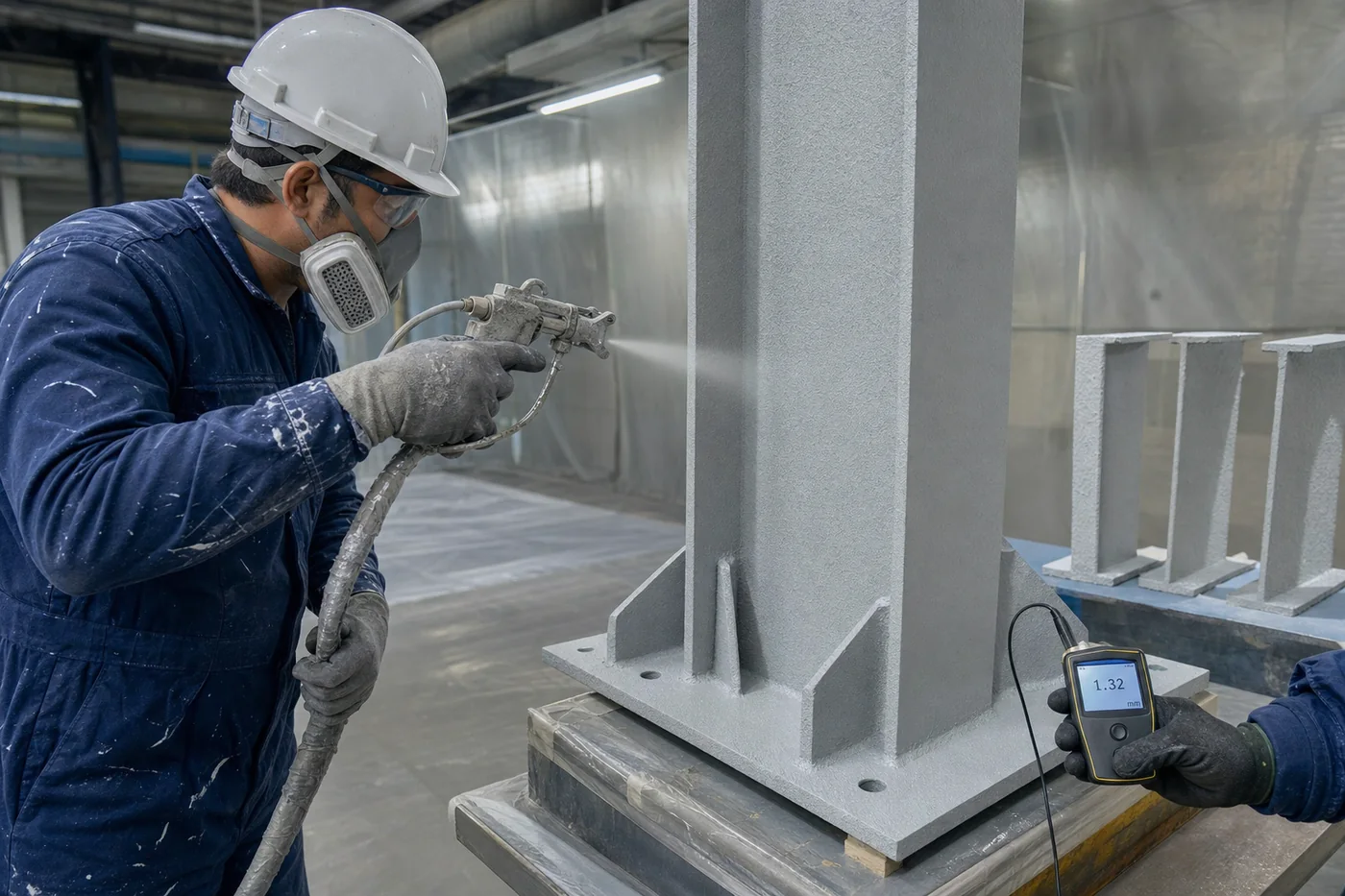
A reliable fireproof coating quotation requires the project documents to define the responsible design, required rating, system, substrate preparation, compatibility, application location, inspection, and approval route.
Buyer Guidance
Ask the buyer's local engineer or fire specialist to confirm the required system and acceptance criteria. Then separate the steel fabrication coating, shop-applied fireproofing if permitted, site-applied work, touch-up, protection, inspection, and document responsibilities in the quotation.
Decision Framework
| Control area | What to define |
|---|---|
| Design basis | Required rating, member exposure, section factor, and local approval route |
| Coating system | Product system, primer compatibility, thickness basis, color, and environment |
| Application scope | Shop or site location, excluded areas, connections, masking, and touch-up |
| Inspection | Responsible party, measurement method, hold points, and acceptance records |
| Packing and repair | Protection during transport and responsibility for site damage or final repair |
Buyer Checklist
Scope and Responsibilities
YYN coordinates the confirmed requirement with the matched production resource and collects agreed progress records. Local fire design, approval, and formal acceptance remain with the responsible fire engineer and inspector.
Application Interface Review
The project professional should identify the required fire performance, protected members, approved system, substrate and primer compatibility, preparation, thickness basis, environmental limits, detailing around connections, excluded surfaces, and inspection method. The quotation should then separate shop preparation, shop application where permitted, masking, curing, handling protection, packing, transport damage, site application, touch-up, final appearance, and document responsibilities.
Before production, confirm whether the selected system affects connection tolerances, bolt areas, member marks, lifting points, welding repairs, or packing supports. Define who measures the applied coating, what instruments or records are required, and who can accept or release the work. Progress photos may document visible activity, but the contract-defined inspection and approval route controls formal acceptance. An unresolved product or application assumption should remain open rather than being converted into a generic included scope.
Member Schedule
A usable schedule should identify each protected member group by drawing reference or mark, profile, exposure condition, required rating, selected tested system, primer condition, finish requirement, application location, and approval reference. Where the responsible designer uses section factor, heated perimeter, mass per unit length, or another calculation input, record the approved value and its source instead of asking the fabricator to infer it from a general note.
Separate columns should cover columns, primary beams, secondary beams, bracing, trusses, connection zones, and any intentionally unprotected steel. This makes omissions visible and lets the quotation distinguish different thicknesses, materials, access conditions, masking needs, and finishing requirements without treating the whole building as one uniform coating area.
Approval Dossier
Approved product data, tested assembly reference, substrate limits, compatible primer, and specified finish.
Batch identity, ambient conditions, preparation status, coat sequence, curing intervals, and repair locations.
Member reference, reading locations, instrument identity, recorded thickness, exception status, and corrective action.
Named reviewer, hold point, submission format, acceptance authority, and unresolved-item register.
Buyer FAQ
No. The buyer's responsible local engineer or fire specialist must confirm the project requirement.
The specification, transport risk, connection details, repair plan, and local approval route determine the appropriate application location.
Formal acceptance follows the contract-defined inspection method and responsible party.
Apply this guide to your project
YYN will identify missing inputs, open assumptions, and the next sourcing or production-review step without replacing project engineering.
 Chat with YYN SteelSteel structure sourcing & project follow-up
Scan with WhatsApp
Phone / WhatsApp+86 193 3892 7935
