
Quotation Comparison Guide
How to Compare Steel Structure Quotations on the Same Basis
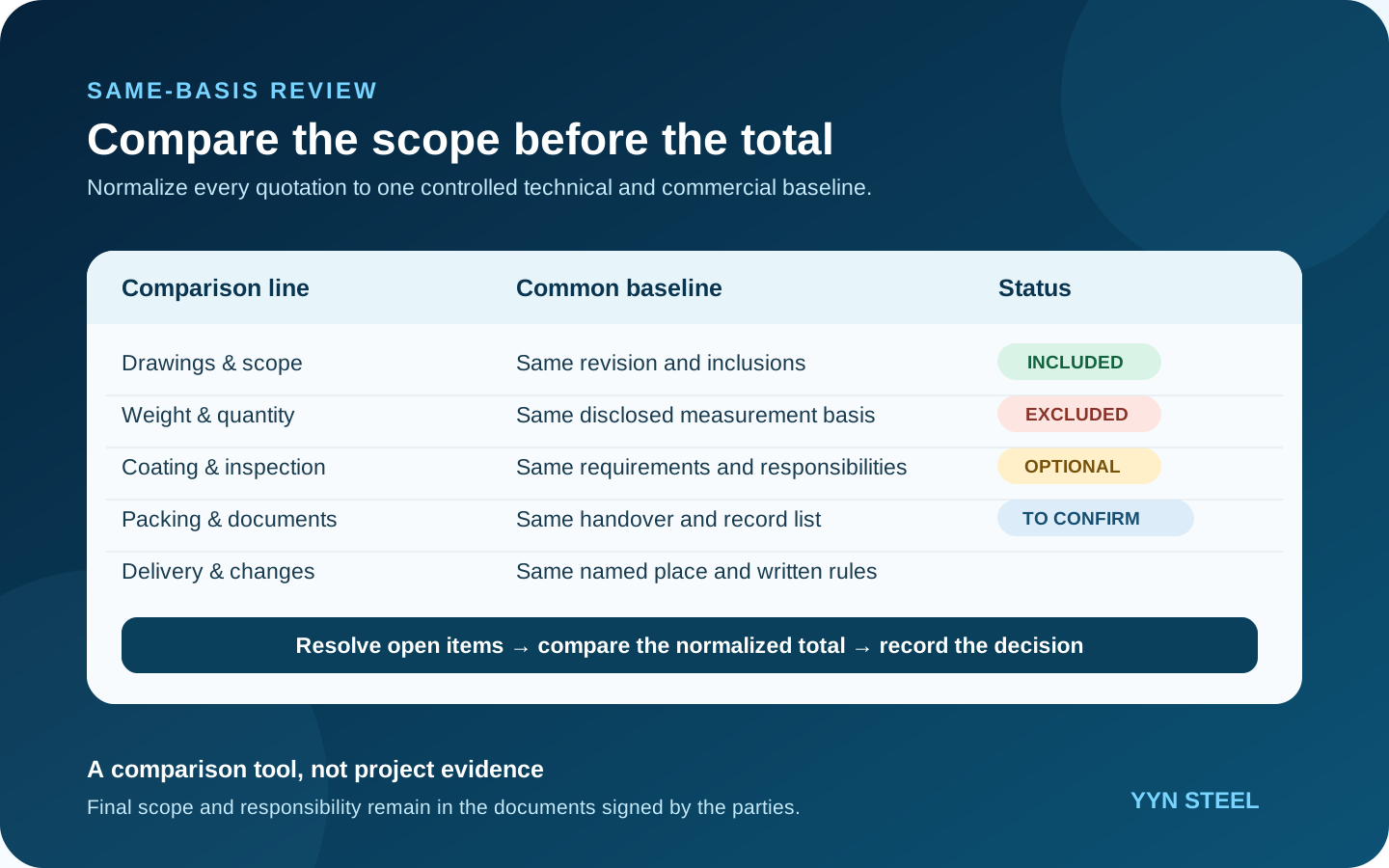
Compare steel structure quotations only after every supplier is measured against the same drawing revision, supply scope, quantity and weight basis, technical requirements, coating, packing, document responsibilities, delivery term, and written change rule. Normalize each line as included, excluded, optional, or to be confirmed before judging the total price.
Short Answer
A steel structure quotation comparison is a line-by-line normalization of what each supplier priced, assumed, excluded, and remains responsible for. The comparison is useful when all offers reference one controlled technical baseline and one commercial delivery basis. It is not a rule that one weight formula, coating system, packing method, inspection plan, or trade term fits every project.
Applicable Scope
Use this guide after quotations have been received.
This guide helps overseas buyers evaluate multiple quotations for one structural package. Use it once inquiry references have been issued plus supplier offers are available. Buyers still deciding what information to send should consult a separate steel structure quotation drawings guide. That resource covers pricing inputs; this guide covers normalization plus commercial evaluation.
Within its United States structural steel industry scope, AISC 303-22 says contract documents should show work nature, quantity plus complexity. ISO 10007 describes configuration-management guidance across a product or service life cycle. Together, these sources support fixing document revisions before evaluation; neither source makes this matrix mandatory worldwide. See the AISC 303-22 official page and the ISO 10007 official summary.
Buyer Inputs
Freeze one comparison baseline before opening the price columns.
- Controlling documentsList the drawing file, revision, date, specification, bill of quantities, and any written clarification used by every bidder.
- Supply boundaryDefine main steel, secondary steel, connections, bolts, accessories, stairs, handrails, cladding interfaces, plus any buyer-supplied items.
- Quantity basisState whether comparison uses a buyer bill of quantities, model take-off, supplier take-off, theoretical weight, or another disclosed basis.
- Finish and protectionState surface preparation, coating or galvanizing input, color, fireproofing boundary, touch-up, records, plus exclusions.
- Packing and recordsDefine marks, bundles, small-parts boxes, packing list, loading responsibility, photos, inspection records, and handover documents.
- Commercial basisState currency, taxes where applicable, payment stages, validity, Incoterms® 2020 rule, named place, required date, and change procedure.
These are buyer-side comparison inputs, not a universal standard form. Where a value is unknown, keep it visible as an open item instead of silently choosing a supplier assumption.
Same-Basis Matrix
Normalize the quotation before comparing the total.
| Comparison line | Common baseline to record | What to ask each supplier | Status |
|---|---|---|---|
| Drawings and specifications | File name, revision, date, clarification register | Confirm every priced document and assumption | Included / To confirm |
| Steel and connections | Grades, member range, plates, bolts, secondary steel | List included items, buyer-supplied items, and exclusions | Included / Excluded |
| Quantity and weight | BOQ or take-off source and measurement basis | Explain theoretical or chargeable weight, accessories, and wastage | Included / To confirm |
| Surface protection | Preparation, system, thickness input, color, touch-up | Name the quoted system, records, responsibility, and exceptions | Included / Optional |
| Quality and inspection | Factory control, project assurance, independent inspection | State performer, payer, records, hold points, and release authority | Included / Optional |
| Packing and loading | Marks, bundles, supports, small parts, loading and securing | State method, limits, records, and responsibility at handover | Included / Excluded |
| Documents | Drawing register, material, production, packing, shipping list | List document name, format, timing, reviewer, and final status | Included / To confirm |
| Delivery | Incoterms® 2020 rule, named place, route assumption, required date | Separate inland, international freight, insurance, and clearance roles | Included / Optional |
| Commercial changes | Validity, currency, tax, payment, written change mechanism | State how scope, drawing, quantity, or delivery changes are reviewed | Included / To confirm |
Do not treat a blank cell as included. Record it as TO CONFIRM until a supplier answers in writing. A normalized total may require adding priced options or removing items outside buyer-required scope, but every adjustment should remain traceable to the supplier's written offer.
Normalization Worksheet
Calculate an adjusted comparison without rewriting supplier offers.
Worksheet notice: This is an illustrative buyer worksheet, not a quotation, contract, engineering document, inspection record, or acceptance decision.
Preserve every supplier total in a source column. Create separate reconciliation columns for required additions; elective options; buyer-unneeded exclusions; arithmetic corrections; currency treatment; unresolved allowances. Assign every adjustment a short code linked to written clarification, an option sheet, or a revised commercial page. A normalized total serves as an evaluation subtotal for like-for-like review. It is neither a negotiated contract price nor a replacement for a signed offer.
- Source valueCopy quoted amount, currency, quotation reference plus validity exactly as issued.
- Adjustment codeClassify each entry as required addition, accepted option, removable scope, calculation correction, or unresolved allowance.
- Evidence referenceLink each entry to dated clarification, revised line item, or supplier confirmation instead of an internal assumption.
- Decision statusMark each entry open, technically accepted, commercially accepted, rejected, or superseded so reviewers can retrace evaluation logic.
Unknown amounts never become zero. Leave such cells open. Name a responsible respondent. Keep uncertainty visible beside each evaluation subtotal. This prevents incomplete offers from appearing artificially precise while preserving original supplier positions.
Open-Book YYN Order Review
Separate factory procurement cost, third-party service costs, and YYN margin.
A YYN order cost schedule preserves the factory procurement basis, lists approved third-party services as separate external charges, states the agreed chargeable steel weight, and shows YYN's total retained project margin as both an amount and a per-tonne result. Third-party service costs do not enter YYN's margin calculation.
| Commercial line | Value to record | Evidence or confirmation |
|---|---|---|
| Factory procurement | Factory amount and included scope | Factory quotation, purchase order, contract, or settlement record |
| Third-party services | Approved external cost charged separately by provider and purpose; excluded from YYN margin | Third-party quotation, invoice, or agreed external cost record |
| YYN project margin | YYN steel order amount minus disclosed factory procurement cost; divided by agreed chargeable steel weight | Signed order cost and margin schedule |
| Margin cap | Not more than USD 100 per metric tonne | All YYN-retained project charges included; separately charged third-party costs excluded |
Read YYN's cost and project transparency policy for the full calculation and project-ownership commitments.
Five-Step Method
Move from document control to a decision record.
- Lock the baseline. Give every quotation a comparison ID and record the exact drawings, specifications, quantities, and clarifications behind it.
- Map the scope. Break each offer into the same technical, document, packing, delivery, and commercial lines.
- Label every difference. Use included, excluded, optional, or to be confirmed; do not infer inclusion from the total.
- Price the confirmed gaps. Request written clarification or an option price where a required line is missing or based on a different assumption.
- Record the decision. Compare normalized totals together with responsibilities, schedule, validity, payment conditions plus unresolved risks.
The result should be a reviewable decision record, not a claim that the lowest quotation is unsafe or that the highest quotation is complete.
Technical Differences
Compare coating, inspection, and packing as defined responsibilities.
Coating
Do not compare offers that simply say “paint included.” AISC's painting guidance says painting should not be assumed and, when required, the contract documents should define matters such as paint, surface preparation, and dry film thickness. Its guidance is United States industry material and project requirements still control. ISO 12944-5's public summary identifies environment, surface preparation, and expected durability as factors in selecting protective paint systems. It does not select a system for your project. Review the AISC painting guidance, the ISO 12944-5 official summary, and YYN's coating and corrosion protection guide.
Quality and inspection
Separate factory quality control, project quality assurance, and independent third-party inspection. AISC 360-22 distinguishes these responsibilities within its building-structure system and places contract-document importance on required quality assurance. Your project contract, specification, authority, and local rules determine the actual plan. Ask who performs each activity, who pays, what record is submitted, and who can release the work. See the AISC 360-22 official page and YYN's project record formats.
Packing and loading
Replace the phrase “export packing included” with named responsibilities for bundles, marks, supports, small-parts boxes, loading, securing, records, and handover. The non-mandatory IMO/ILO/UNECE CTU Code discusses transport-unit suitability, packing, securing, responsibility chains, and receiving considerations. It does not replace carrier limits, qualified cargo-securing design, the contract, or destination law. See the UNECE CTU Code page and the steel structure export packing guide.
Delivery Basis
Write the Incoterms® rule and named place, then define the remaining scope.
An Incoterms® 2020 rule without a named place is not a complete comparison entry. The ICC Academy explains that “C” and “D” rules allocate important delivery, risk, transport, cost, insurance, clearance, packaging, marking, or document responsibilities differently. Its article is educational and does not replace the official rules or the parties' contract. The trade term also does not define steel grades, connection scope, coating, inspection, payment, or title. Read the ICC Academy Incoterms® 2020 article.
For each offer, record the rule version, named place, included route, freight assumptions, insurance responsibility, export and import clearance roles, and the point used for required delivery date. Keep these entries beside the price rather than in an unlinked email.
Written Change Control
Preserve the comparison basis after selection.
A comparison matrix loses value if later revisions are not recorded. AISC 303-22 supports controlled drawing and contract-change practices within its stated industry scope. FAR 52.243-1 provides a United States federal fixed-price contracting example in which written changes may address drawings, specifications, shipment, packing, or delivery and may lead to contract modification. The FAR clause applies only when incorporated into the relevant federal contract; it is not a rule for ordinary commercial orders. See FAR 52.243-1 on Acquisition.gov.
For a commercial steel structure order, identify the changed document and affected scope, then record the agreed price or schedule effect under the signed contract. YYN's stated approach is that when drawings, quantity, technical requirements, supply scope, and delivery conditions remain unchanged, YYN does not unilaterally adjust the confirmed contract price; scope changes require written confirmation. The final contractual position is always the one in the documents signed by the parties.
Responsibility Boundary
Comparison supports a purchase decision; it does not replace project engineering or formal acceptance.
The buyer's appointed professionals remain responsible for design criteria, local code compliance, approvals, site conditions, interfaces, and installation engineering. Contract-defined parties remain responsible for formal quality control, quality assurance, independent inspection, acceptance, transport, customs, and insurance. YYN can organize the China-side quotation baseline, supplier clarifications, comparison matrix, and agreed follow-up records. YYN photos and routine updates support visibility but are not third-party inspection or certification.
YYN Comparison Workflow
What YYN can organize before an order is confirmed.
YYN can register the drawing revision, quantity basis, technical requirements, supply scope, and delivery condition used for each offer. The comparison table can then separate inclusions, exclusions, options, open points, and written clarifications. This is YYN's project-control method, not a standard-body requirement. The buyer receives a clearer basis for deciding which differences need technical review, supplier repricing, or contract wording.
To start a project-specific comparison, provide the quotations together with the controlling drawings, scope schedule, specifications, destination, and required date. Sensitive commercial files should be shared through the agreed project channel. Use the China steel structure buying risk guide for wider counterparty and execution controls.
Quotation Comparison FAQ
Questions buyers ask after receiving multiple offers
What is the first step when comparing steel structure quotations?
Confirm that every quotation uses the same drawing revision, scope schedule, quantity basis, technical requirements, coating basis, packing responsibility, delivery term, and named place.
Should I compare quotations by price per ton?
Only after confirming that the quoted weight and supply scope use the same basis. Ask whether bolts, secondary steel, accessories, wastage, coating, packing, documents, and freight are included.
How should I compare coating prices?
Compare the specified surface preparation, coating system or project-defined equivalent, thickness requirement, color, touch-up responsibility, records, and exclusions rather than comparing a generic “painted” label.
Does an Incoterms® rule define the whole quotation scope?
No. The selected Incoterms® 2020 rule and named place help allocate delivery, risk, and cost responsibilities, but the technical supply scope, quality, payment, and ownership terms still need separate written agreement.
Is the lowest total quotation automatically the best choice?
No automatic conclusion should be made from the total alone. First resolve excluded, optional, and unconfirmed items, then compare the normalized total together with responsibility, schedule, and commercial conditions.
How should quotation changes be controlled?
Record the changed drawing, quantity, technical requirement, supply scope, packing, or delivery condition; then document any agreed price or schedule effect in writing under the applicable contract.
Can progress photos replace formal inspection?
No. Photos can support project visibility, while formal quality control, quality assurance, acceptance, or independent inspection follows the parties and methods defined in the contract and project requirements.
Apply this guide to your project
Send the available documents and the decision you need to make next.
YYN will identify missing inputs, open assumptions, and the next sourcing or production-review step without replacing project engineering.