Buyer Question
How to Control Steel Structure Scope Changes After a Quotation
A scope change is manageable when everyone can identify the revision, compare its effect, and record the decision before it is treated as current.
Quick answer
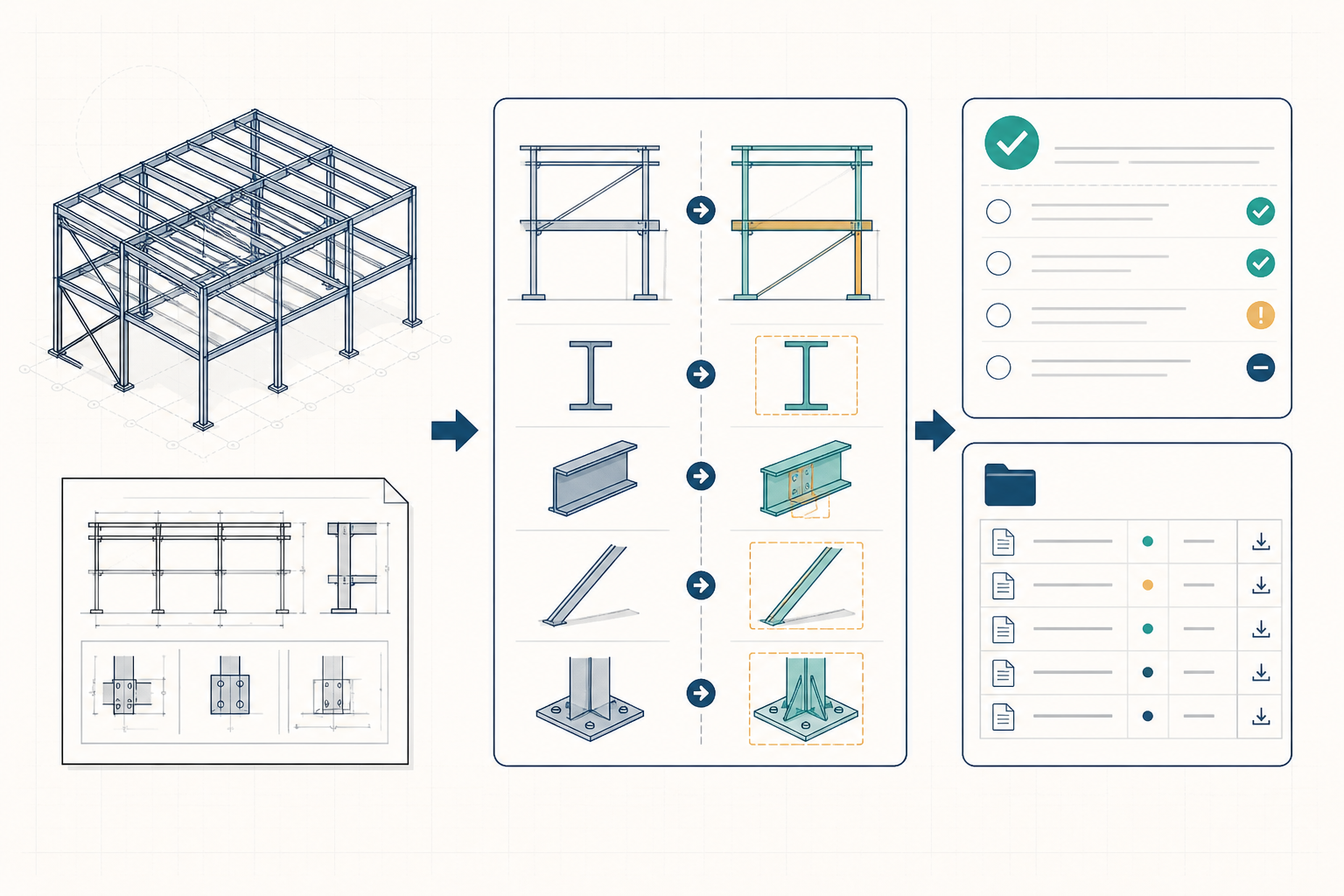
Do not manage a change through an isolated message or a revised drawing alone. Give it an ID, identify the controlling revision, compare the effect against the quoted basis, record the required decision, and issue a clear current-status record. This keeps open assumptions visible before they become a cost, schedule, or handover dispute.
Change identification
First decide whether the quoted basis has changed.
A scope change is not limited to a new member size. It can arise when a drawing revision changes quantities, connection details, material grade, coating system, packing requirement, document requirement, delivery sequence, or an interface with other work. A clarification that confirms the original basis is not necessarily a change; the record should say why it does or does not alter that basis.
| Question | Useful record |
|---|---|
| What was quoted? | Quotation reference, issue date, drawing/specification list, assumptions and exclusions. |
| What differs now? | Revision number, marked comparison, affected work package, and request source. |
| What can it affect? | Quantity, material, fabrication sequence, coating, packing, documents, schedule, or price—only where confirmed. |
| What happens next? | Decision owner, required input, due date, and release status. |
Change register
Use one register instead of scattered revision notes.
A compact register gives buyer, designer, supplier, and coordinator a shared reference. It does not replace a contract variation procedure or engineering approval; it gives those formal processes a traceable working index.
- Unique change ID and date received
- Source document and superseded/current revision
- Plain-language difference and affected package
- Confirmed effect, open effect, and missing inputs
- Decision owner, date, and resulting instruction reference
- Status: proposed, under review, accepted, rejected, or superseded
Decision sequence
Keep technical approval, commercial agreement, and production release distinct.
Begin with the buyer-appointed professional’s controlled drawing or technical instruction where formal engineering approval is required. Compare the requested work with the quotation basis on the same scope. If an effect is not confirmed, record it as open rather than settled. When responsible parties decide, identify which document controls the affected work and communicate that status clearly.
A revised drawing is not automatic authorization for every cost, schedule, or fabrication consequence. Signed documents and the agreed change process define contractual responsibility; a change log makes the decision trail easier to review.
Scope and responsibilities
Coordination improves visibility; it does not replace formal authority.
YYN can support quotation and scope coordination, production follow-up, evidence coordination, and export handover support. Formal design approval and local code compliance remain with the buyer-appointed professional. Contracting entity, payment route, scope, and responsibility follow signed documents. Photos or coordination records do not replace controlled drawings, measurements, testing, formal inspection, or signed acceptance.
Apply this guide to your project
Send the documents you have and the scope decision you need to make next.
YYN can identify missing inputs and open assumptions without replacing project engineering.